Labour and City Life Discovery Centre
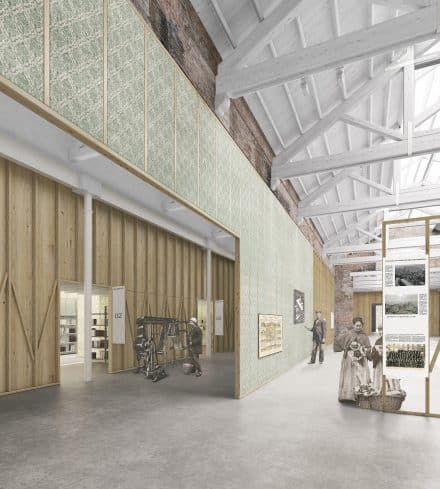
Conversion of a mid-19th-century industrial building (Nave F) into a museum facility connected to the memory of the Fabra i Coats complex and, more broadly, of Barcelona itself.
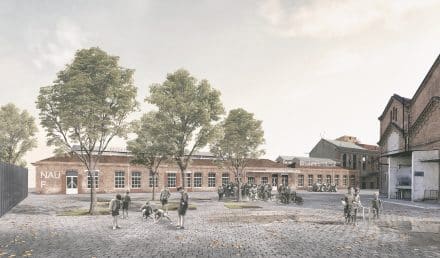
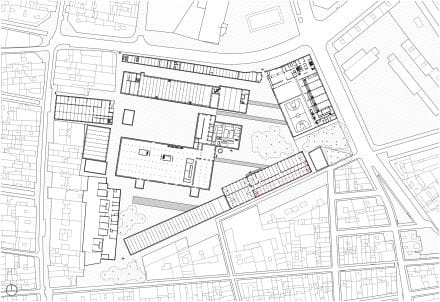
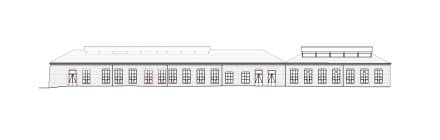
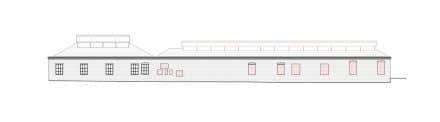
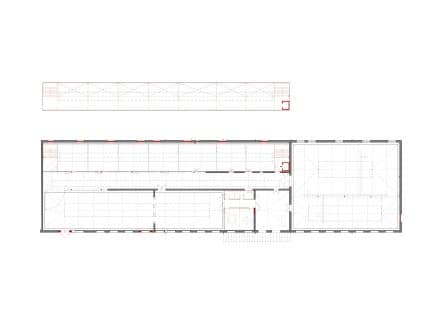
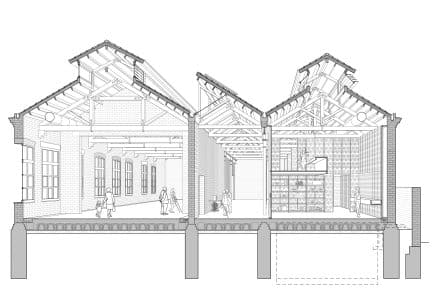
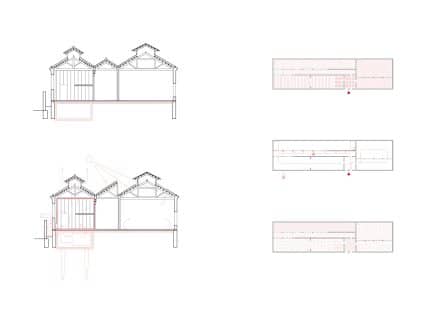
The building is conceived in relation to other spaces within the complex, both functionally—through its link to the boiler room and the creation of synergies—and physically, with elements such as a new entrance canopy and continuous paving.
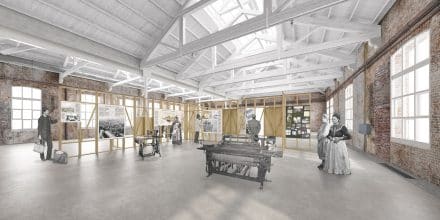
The program is distributed in accordance with the building’s five-bay structure. Exhibition areas, for instance, occupy entire bays, reinforcing the logic of the original layout. All spaces are designed to operate independently, allowing them to be opened or closed without affecting other functions. The agora, together with its support spaces, can function on its own as a venue for activities serving the wider complex.
Key architectural qualities—such as the openness of the space, the structural system, the rhythm of windows, and the original materials and construction techniques—are integrated into the project as heritage values. The intervention seeks to make the most of the existing structure while preserving its constructive honesty, avoiding concealment or alteration. Instead, it focuses on reconciling this historical character with the demanding requirements of contemporary regulations, including structural and fire safety standards.
The façades will be carefully restored, reestablishing the original arrangement of openings while avoiding any form of historical imitation. Surfaces will remain in exposed brick; where new elements are introduced, they will be clearly distinguishable through their materiality. New openings will be subtly differentiated from the original ones by means of deliberately visible metal lintels, replacing the traditional brick arches. The roofs will be rebuilt to improve thermal performance and unified with flat ceramic tiles. Existing skylights will be reconstructed according to their original section and fitted with operable, motorized wooden windows to ensure natural ventilation.
Where possible, traces of the building’s successive transformations—evidence of its layered history—will be preserved throughout the deconstruction process, including remnants of demolished walls, suspended ducts, and surface finishes.
All new interior partitions will be constructed using a modular timber “balloon frame” system, clearly superimposed onto the historic structure. This same system will also support exhibition elements and form the structure of the mezzanine within the archive space.
In certain areas, these new enclosures will be finished with wallpaper, introducing a degree of domesticity and evoking the imagery of the 19th-century city, which lies at the heart of the interpretation center.
Address: Fabra i Coats, Sant Andreu
Competition: 2018, 6th prize
Architects: Taller 9s (Oriol Cusidó, Irene Marzo) + Vora (Pere Buil, Toni Riba)
Collaborators: Pol Bosch, Gonzalo Pérez
Structures: Eskubi-Turró
Building services: AIA Activitats i Instal·lacions Arquitectòniques
Sustainability: Dekra
Cost management: Joan Olona
Acoustics: Higini Arau
Images: Ikokora