girona historical archive


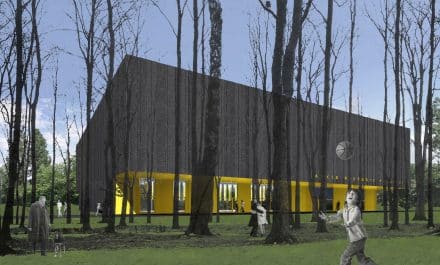

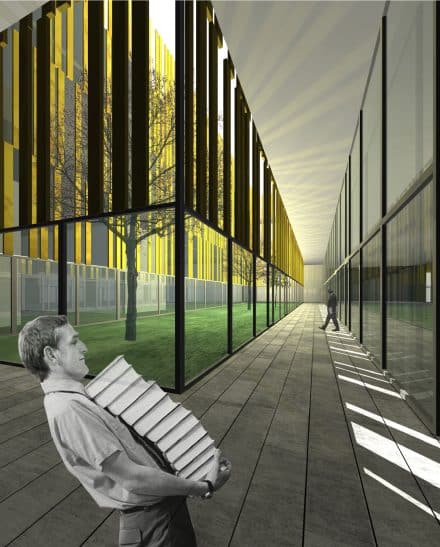


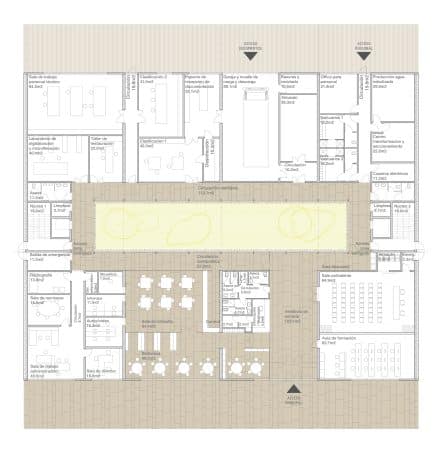
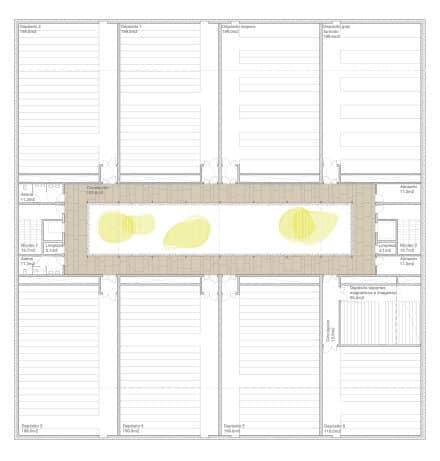


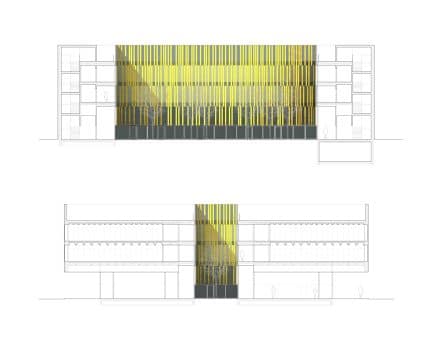

The Provincial Historic Archive in Girona houses a collection of documents of great importance. There are remarkable notarial deeds from the 11th century until 1907, reflecting the functioning of society throughout different eras. This collection holds great historical value and is considered the second most significant in Spain. It also includes notable Hebrew documents, both on paper and parchment, from the 14th and 15th centuries, as Girona had a historically important Jewish community.
While these key documents stand out, the archive is above all an accumulation of memory—a condensed image of society and its history.
The reflection on the social role of an archive and its relevance in today’s world is essential in approaching the design of the building that must house it. Beyond its technical and functional requirements, a more abstract reflection leads us to a form—an image—we believe the building must project. Through this image, the building presents itself to its users and, on another level, to the public. It must be consistent with the significance of its content and its usefulness to our society.
The guiding ideas that shape the final form of the building are:
Protecting the memory. In addition to meeting technical requirements for document protection—such as security and environmental control—the building must resonate with the ancient nature of its contents. Its configuration embraces principles such as durability, with the use of long-lasting materials like stone, concrete, stable metals, and dense woods; and stability, in an abstract sense: a structure that can adapt to cultural and social changes without losing relevance. It should be a strong, aesthetically autonomous building, resistant to trends.
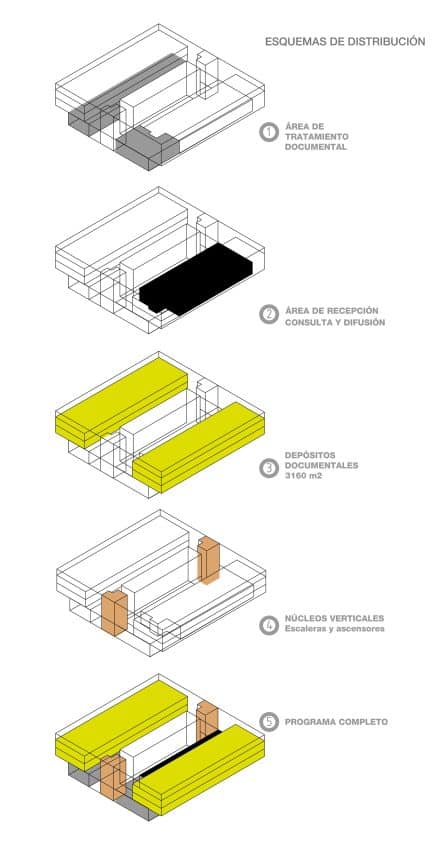
Accessing the memory. The institution and its content carry deep symbolic weight. The building must therefore express monumentality while also inviting access. The tension between open and closed elements is both formal and conceptual. At the scale of the city, the building is self-referential, clearly visible from its surroundings. The archive volume is elevated in the upper floors, establishing a symbolic and visual relationship with the city. At a more human scale, the building must awaken curiosity and encourage entry, with a more open and luminous ground floor and visual transparency toward the interior.
The content itself—books, documents, bindings— is the true protagonist. Just like a book, the building is wrapped in protective covers, shielding the information inside. When opened, it reveals a luminous interior, inviting people to explore, search, and discover. The architectural image of the building draws inspiration from the idea of bound documents.
The outer shell is treated like the cover of a book, using a textured surface of stone in varying thicknesses, vertically striated without an apparent order—evoking the accumulation of memory on the shelves, the layers of history.
The opened pages are expressed through the transparent ground-floor façade, revealing the building’s interior and reflecting the value of its contents. The underside of the porch and the glazed façade are treated with transparent glass and gold cladding to create a luminous, guiding texture. This refers to the golden script found in incunabula and the gilt-edged margins of antique books.
Finally, letters are applied to the façade in gold over basalt, just as titles and details are traditionally marked on the spines and covers of bound volumes.
Address: Rambla Xavier Cugat, Fontajau, Girona
Total built area: 6,400 m²
Competition: 2008
Architects: vora (with Toni Riba) + virai (Juan Herranz, Marta Parra)
Project collaborators: Alessandro Cozzo, Eva Cotman, Arnau Boronat (vora arquitectura), Marta Alonso Yebra, María Ibarra Ciordia, Stepan Martinovsky, Teun van Veggel (virai arquitectos)
Structural consultant: GV408 Arquitectura
MEP consultant: DProl Instalaciones
Environmental consultant: Aiguasol Enginyeria (Daniel Gonzàlez)
Cost consultant: Gerard Codina Prats
Client: Ministry of Culture
Images: Pere Abelló Boix