sant esteve sesrovires cementery
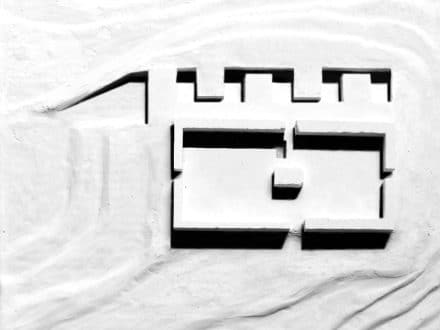
The Place of Absence. The Cemetery.
Death is understood either as the end of life or as a transformation into another state of being. In any case, death represents a disappearance—an absence. With this in mind, we sought to develop this cemetery proposal based on the concept of emptiness: the place of absence.

The Place of Absence. The Cemetery.
Death is understood either as the end of life or as a transformation into another state of being. In any case, death represents a disappearance—an absence. With this in mind, we sought to develop this cemetery proposal based on the concept of emptiness: the place of absence.

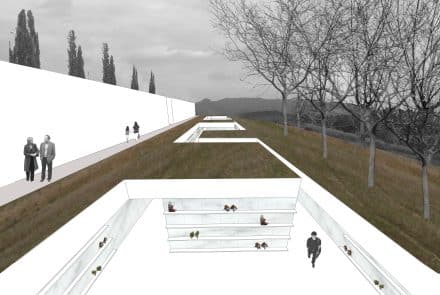

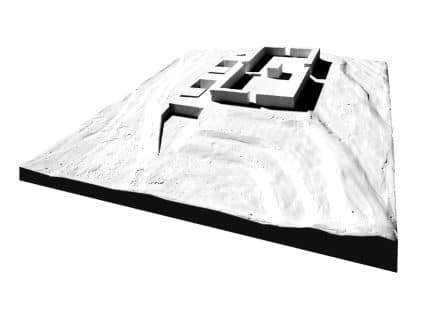
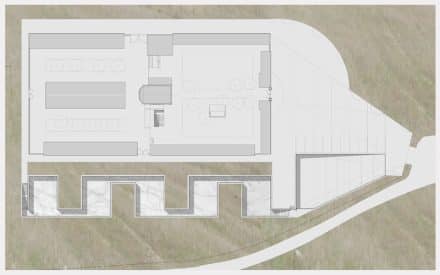
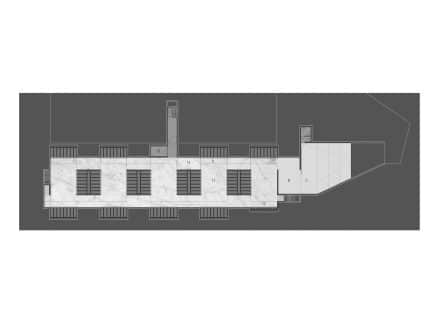

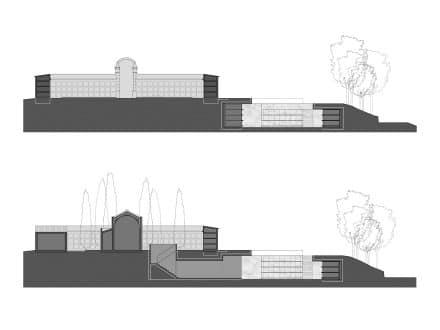
Excavated Space.
The existing cemetery is located on a raised area of land. The extension is carved into the northeastern side of this elevation. This excavation allows the new cemetery space to be created without altering the image of the existing one—an image that lives on in the memory of the townspeople and is tied to the traditional cemetery typology.
Enclosed Space.
The void creates an inner, intimate space, enclosed by the very earth itself. As you descend, the surrounding landscape gradually disappears; once inside the cemetery, the only visible reference is the sky.
Anonymous Space.
The cemetery has no façade—it is not a house. Entry is through a large, gently sloping plane that slowly guides you into the cemetery. A double wall subtly shifts the path, like a river meandering and slowing its flow before reaching the sea.
Relationship with the Existing Cemetery.
The new cemetery is formally autonomous, governed by its own set of rules, and has a clearly distinct character. Functionally, several connections are established to ensure smooth circulation between the two areas. The extension engages in a layered dialogue with the existing cemetery, respecting its image and the symbolic hierarchy it holds in relation to the village.
Exterior–Interior Contrast. Material and Symbolic Contrast.
The exterior, connected to the world of the living, uses contextual materials: concrete, earth, vegetation… while the entire interior is envisioned in white marble. The ground is covered with a bed of white marble pebbles that reflect light and accompany the visitor with the soft sound of footsteps.
The cemetery becomes a luminous, sensory, and abstract space—transporting us to a special realm—and remains like a fossilized imprint in the landscape.
adress: sant esteve sesrovires (penedès)
surface area: 1.200 m2
competition: 2008
architects: vora (with toni riba)
project team: eva cotman, alessandro cozzo
client: municipality of sant esteve sesrovires